The Bottleneck Nobody's Talking About
" The first step to changing your results is shifting your perspective.”
- Nancy Margrit
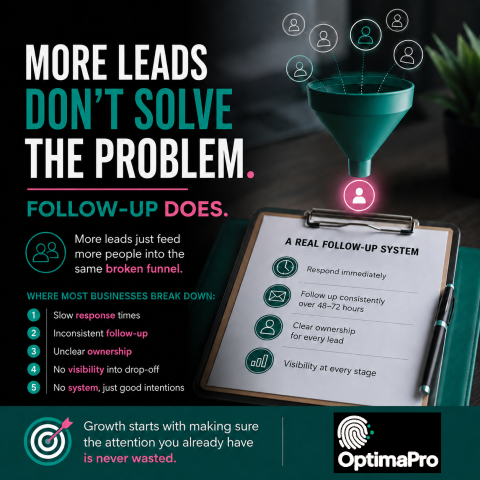
Most business owners think their growth problem is a leads problem. Get more leads, get more calls, get more people in the door, and revenue follows. It sounds logical. It is also usually wrong.
Whether you run a medspa, a functional medicine practice, a chiropractic office, or a service-based agency, the pattern looks the same. Marketing brings in interest. Then the follow-up breaks down. A form gets filled out and nobody responds for two days. A voicemail sits unheard until Friday. A warm lead goes cold because the system that was supposed to catch them never existed in the first place.
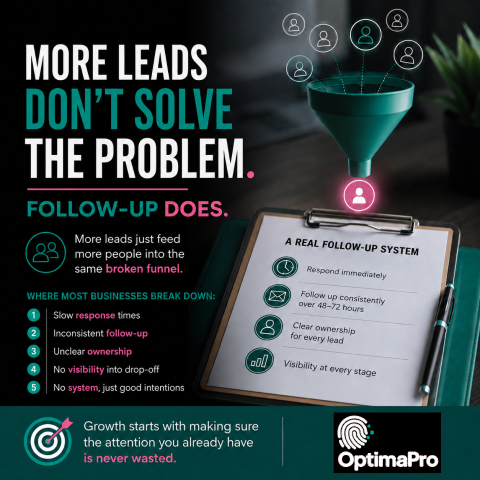
More leads do not fix that. They just feed more people into the same broken funnel.
Where the breakdown actually happens
If you want to know whether your business has a lead problem or a follow-up problem, look at these five points.
1. How fast does a new lead get a response? If it is measured in hours or days instead of minutes, you are losing people who already raised their hand.
2. What happens after the first contact? If there is no consistent second, third, or fourth touch, you are relying on the prospect to chase you.
3. Who owns follow-up when your team is busy? If the answer is whoever has time, the answer is often nobody.
4. Can you see where prospects are dropping off? If you cannot point to the exact stage where interest turns into silence, you cannot fix it.
5. What tools are you using to track this? A sticky note, a shared inbox, and good intentions are not a system.
Most businesses do not need a marketing overhaul. They need to look at the five points above before spending another dollar on lead generation.
Why this matters more in medical and wellness practices
In a clinic, medspa, or concierge health practice, the cost of slow follow-up is not abstract. A prospective patient who does not hear back within a day will often book with the practice down the street that did respond. That patient represents ongoing visits, referrals, and lifetime value, not just one appointment. Losing them to a slow intake process is one of the most expensive and least visible leaks in the business.
Why this matters just as much for service businesses
Agencies, consultants, and other service-based businesses face the same math with different language. A prospect fills out a contact form, gets a generic auto reply, and waits. Three days later, they have already scheduled a call with a competitor who followed up in twenty minutes. The lead was never lost to bad marketing. It was lost to bad timing.
What a real follow-up system looks like
A working system does not require more staff or more hours in the day. It requires structure.
1. Immediate acknowledgment the moment someone reaches out, even if a human has not seen it yet.
2. A defined sequence of follow-up touches across the first 48 to 72 hours, not a single email and silence.
3. Clear ownership so every lead has a name attached to it, not a shared inbox everyone assumes someone else is watching.
4. Visibility for the owner, so you can see conversion rates by stage instead of guessing where things are breaking down.
This is exactly where practical automation earns its place. Not to replace the conversation, but to make sure no prospect falls through simply because your team was with a patient, a client, or on another call. The goal is not to remove the human touch. It is to protect it, so your team's time goes toward the conversations that actually need a person, not chasing down leads that should have already been captured.
Where to start
Before adding another marketing channel or lead source, look at your last 20 inquiries. Track how long it took to respond, how many touches happened after that, and how many went quiet without an obvious reason. That one exercise usually tells you more about your growth ceiling than any campaign will.
Growth does not start with more attention. It starts with making sure the attention you already have is never wasted.